Why an imbalance costs you
This is worth checking because the buying pattern is real, not an assumption. We looked at the orders recorded in BL Metrics to see how often someone who buys a left-side part also buys its mirrored counterpart:
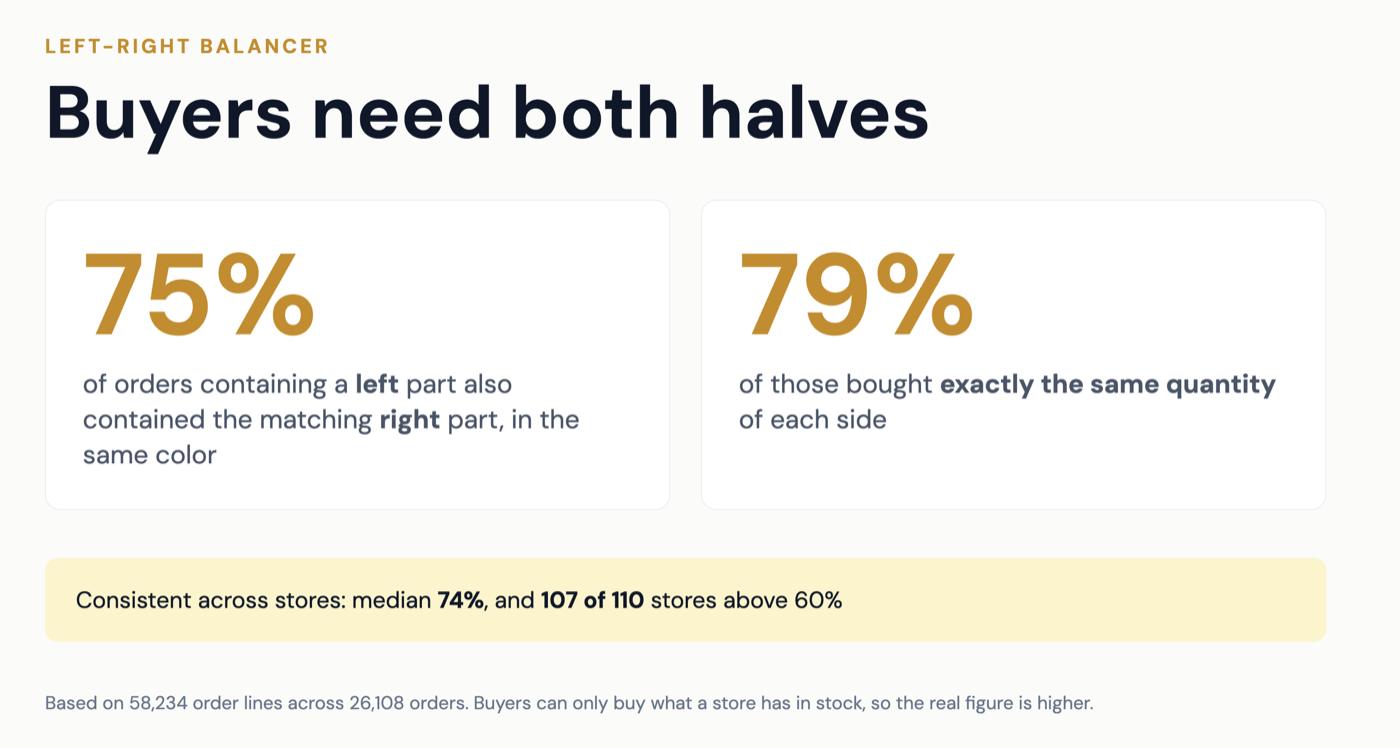
Across more than 26,000 orders containing a left-side part, 75% also contained the matching right part in the same color, and 79% of those bought exactly the same quantity of each side. That holds across stores rather than being one shop's habit: the median store sits at 74%, and 107 of the 110 stores we measured were above 60%.
That 75% is a floor, not a ceiling. A buyer can only buy what you stock, so every time someone wanted both sides and you only had one, it counts in our data as a single-sided purchase. Real demand for matched pairs is higher than the sales show.
Which is why an imbalance costs more than it looks. If you hold four right wedges and no left ones, you are not just missing four sales. You risk the whole basket, because a buyer filling a wanted list will order from the store that can supply all of it rather than split the order and pay shipping twice.
How it works
The tool reads your synced store inventory, finds every part in the catalog that has a mirrored counterpart, and lists the ones where the two sides do not match. Pairs that are already even are left out, so everything you see is something you could act on.
- It works color by color. A dark green wedge left and a black wedge right are no use to the same buyer, so each color is treated as its own pair.
- It combines your new and used quantities, the same way the Restock checker does.
Reading the table
Each row is one mirrored pair in one color, with the left part on the left of the table and the right part on the right, and your quantity of each in between.
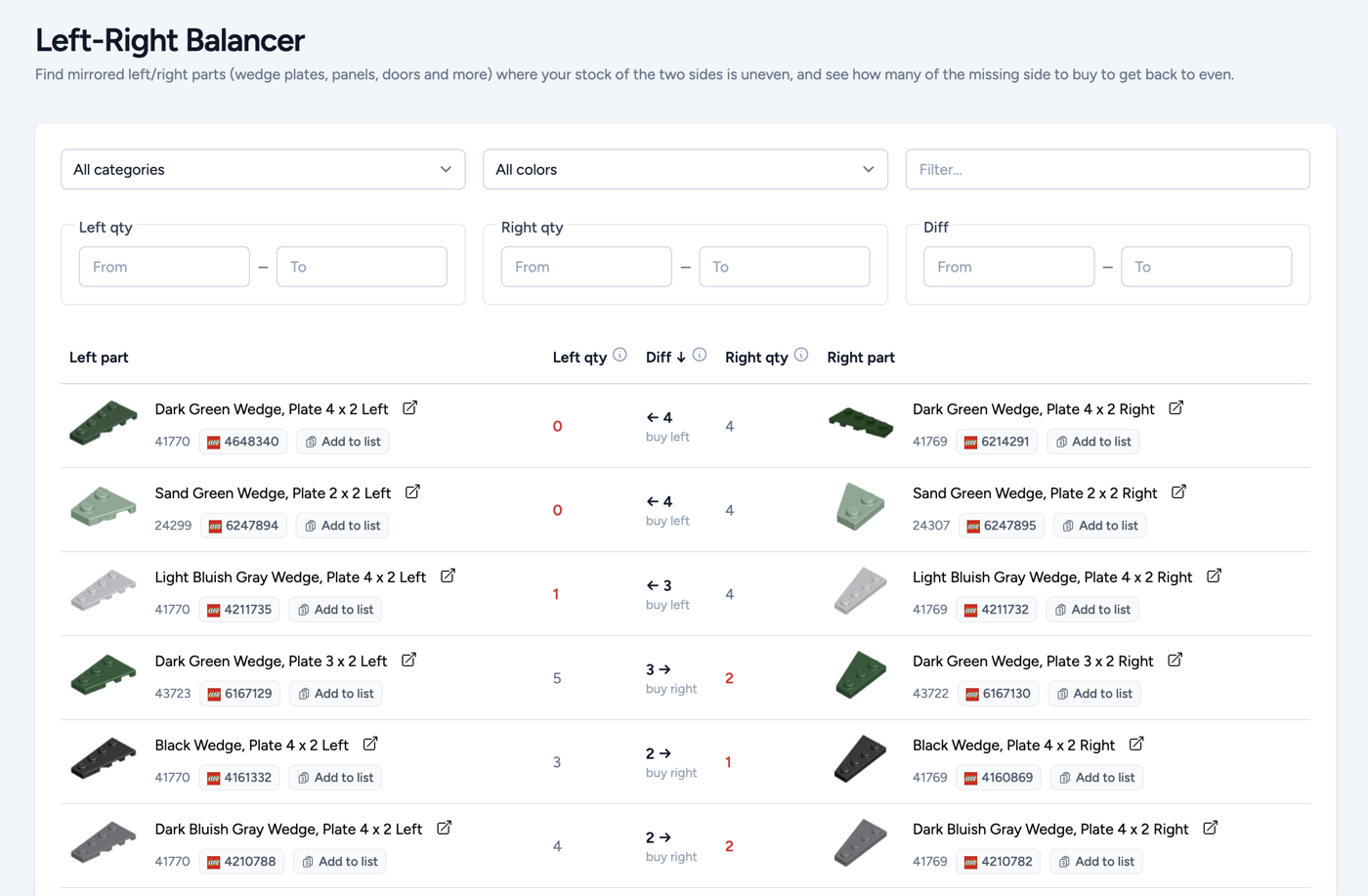
The Diff column in the middle is the tool. It shows how many units the pair is out by, and the arrow points at the side you are short of, with buy left or buy right underneath. The deficient quantity is highlighted in red, so you can scan the column without reading a word.
Take the first row above: zero dark green wedge plate 4 x 2 left, four of the right, so the suggestion is to buy four left. The third row has one left against four right, so it suggests three. The number in Diff is always exactly what it takes to get level.
By default the list is sorted by that difference, largest first, so your worst gaps are at the top. You can sort by either side's quantity instead if you would rather work through it differently.
Filters
- Category: narrow to just the wedge plates, the panels, the doors, and so on.
- Color: narrow the list to the colors you actually trade in, or work through one color at a time instead of jumping around the list.
- Text search on the part name or number.
- Range filters on the left quantity, the right quantity and the difference.
The range filters are more useful than they look. Setting the left or right quantity to a maximum of zero gives you only the pairs where you hold none at all of one side, which are usually the ones worth fixing first. Setting a minimum on the difference hides the pairs that are out by one or two and not worth a purchase.
Turning it into an order
Every part in the table carries the usual list badge, so you can add the missing sides to one of your lists as you work down the page. Once the list is built you can export it as a BrickLink wanted list or a Pick A Brick CSV and buy the lot in one go.
The suggested number balances your stock, it does not tell you whether the part is worth stocking at all. The Balancer does not look at demand. If it suggests buying forty of something, check how that part actually sells before committing.
Summary
This is not a problem you would ever find by hand. It is spread across hundreds of lots and each individual gap looks trivial, which is exactly why it goes unnoticed. But every one of them is a buyer who could not complete their list in your store. Worth opening every few weeks, and especially after you have parted out a few sets, since that is usually where the imbalance creeps in.