Running a successful Bricklink store is all about one thing: sourcing the right parts at the right price. Whether you're just starting out or looking to scale, knowing where and how to get inventory is the difference between a hobby and a real business.
In this guide, we'll walk through the main sourcing strategies available to Bricklink sellers, and show you how BL Metrics can help you make data-driven decisions at every step.
1. New Set Partouts
Parting out new LEGO sets is one of the most popular and accessible sourcing methods. You buy a set at retail (or below), break it down into individual parts, minifigures, and instructions, then list everything on Bricklink.
How to evaluate a set
Not every set is worth parting out. You need to compare the cost of the set against the total value of its parts when sold individually. Two key metrics help you decide:
- Part Out Value (POV): The total value of all parts in the set, based on the 6-month average selling price on Bricklink. A POV multiplier of 2x means the parts are worth twice the retail price.
- ROI (Return on Investment): A more realistic metric. It accounts for which parts will actually sell within 6 months based on their Sell-Through Rate (STR). A high POV is meaningless if half the parts sit in your inventory for years.
On BL Metrics, head to any set page to see both POV and ROI calculated for your specific region and condition (new or used). You can also adjust the purchase price to match what you actually paid.
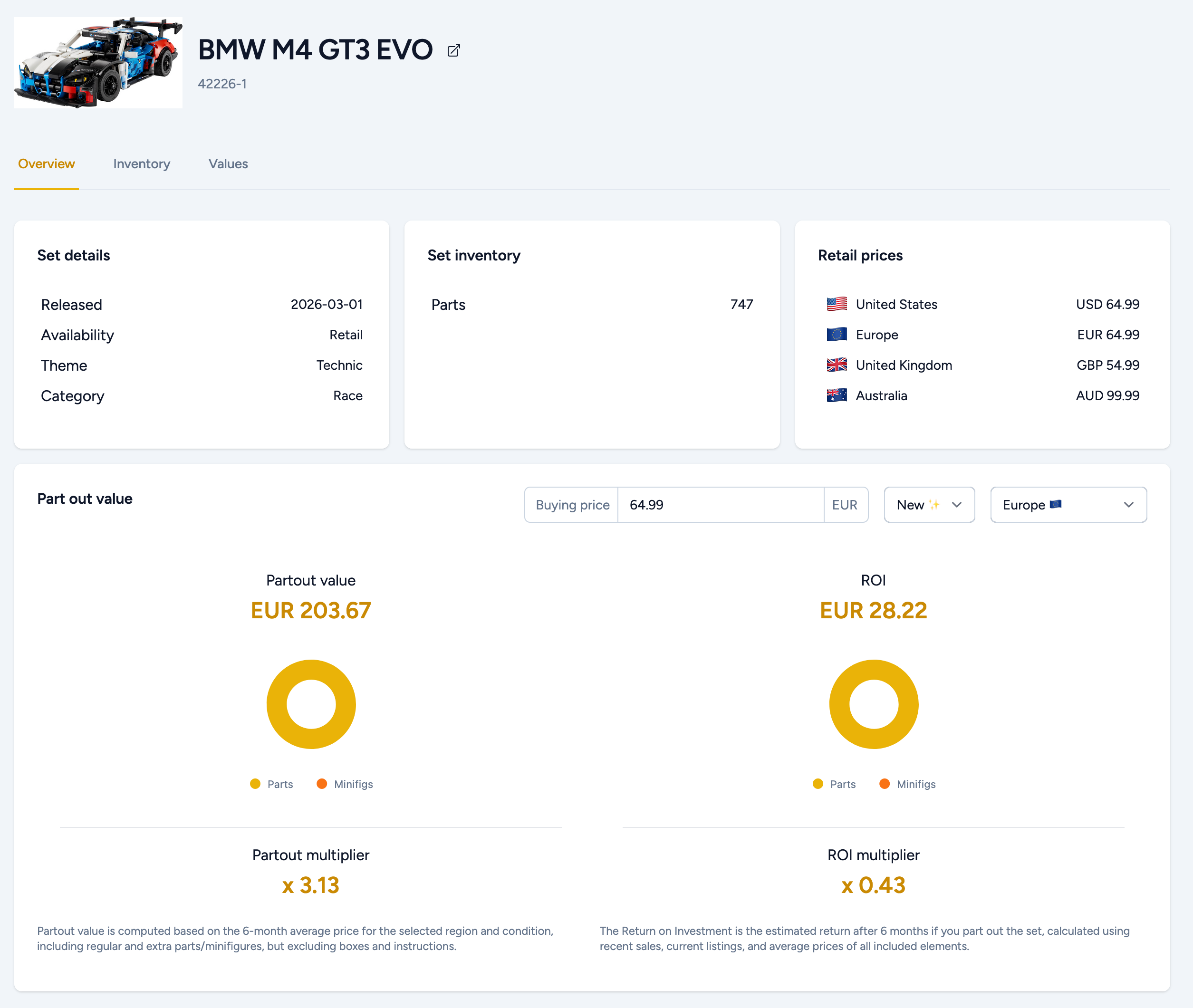
Always look at the ROI multiplier alongside the POV. A set with a 3x POV but a 0.5x ROI means most of that value comes from slow-selling parts.
Set Recommendations
Manually checking every set is time-consuming. That's where Set Recommendations comes in.
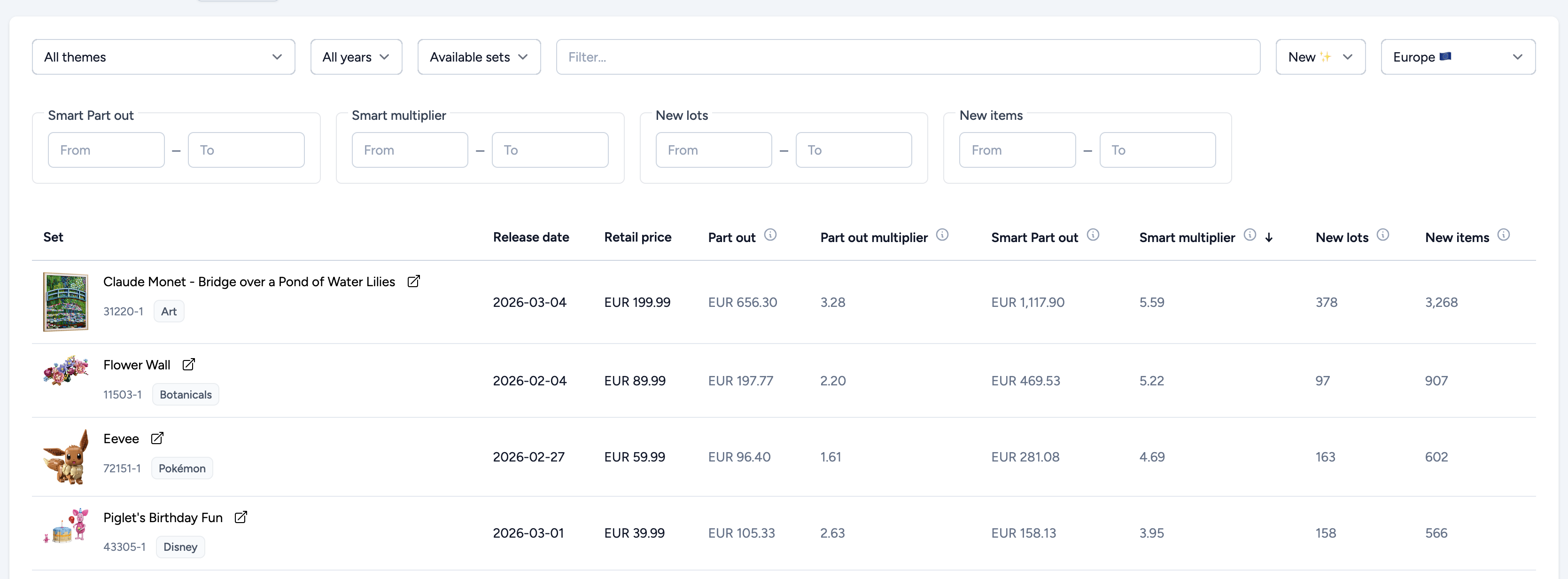
This feature analyzes hundreds of sets against your own Smart Pricing formula and your current inventory. It ranks sets by:
- Smart Partout Value: What the parts are worth using your pricing strategy, not just the market average.
- Smart Partout Multiplier: The return multiple using your formula.
- New Lots %: How many new part/color combinations this set would add to your store. A high percentage means the set diversifies your inventory rather than stacking duplicates.
You can filter by available or retired sets, year range, themes, and minimum multiplier. It's the fastest way to find your next partout candidate.
Tips for set partouts
- Buy on sale: Wait for retailer discounts, VIP points multipliers, or clearance events to maximize margins.
- Target retiring sets: Sets about to retire often have strong partout values, especially if they contain unique or exclusive parts.
- Consider the labor: A 5,000-piece set might have a great multiplier, but it also takes hours to sort, inventory, and list. Factor your time into the equation.
2. Buy from Other Bricklink Stores
Another powerful strategy is buying underpriced inventory from other sellers. Some store owners price aggressively to move stock quickly, retire from the hobby, or simply don't track market values closely.
Store Arbitrage
BL Metrics offers a dedicated Store Arbitrage tool that does the heavy lifting for you.
It compares another store's prices against your Smart Pricing formula and shows you the markup percentage for every item. You can then cherry-pick the most profitable parts and export them as a Bricklink wanted list or BSX file.
What you see for each item:
- The store's current price
- Your Smart Price (what you'd list it for)
- The markup percentage (your profit margin)
- STR, volume, and demand data to confirm the item actually sells
Two modes are available:
- Manual: Enter a specific store name and analyze it on-demand.
- Automated: Set up filters (country, store size, item types, price ranges) and let BL Metrics continuously scan stores for opportunities in the background. When a match is found, you get notified.
When buying from another store, factor in shipping costs. A 30% markup on a single cheap part won't be profitable after shipping, but a 30% markup on a large order with many items can be very worthwhile.
Tips for store arbitrage
- Buy in bulk from one store: Combine multiple underpriced items into a single order to spread shipping costs across many items.
- Focus on high-STR items: Parts with a strong Sell-Through Rate will turn into cash faster.
- Look for store closing sales: Stores that are winding down often list entire inventories at deep discounts.
3. Buy Parts from Pick a Brick
LEGO's Pick a Brick (PAB) service lets you buy individual elements directly from LEGO at fixed prices. Some of these elements are significantly cheaper than their Bricklink market price, which creates arbitrage opportunities.
Finding the good deals
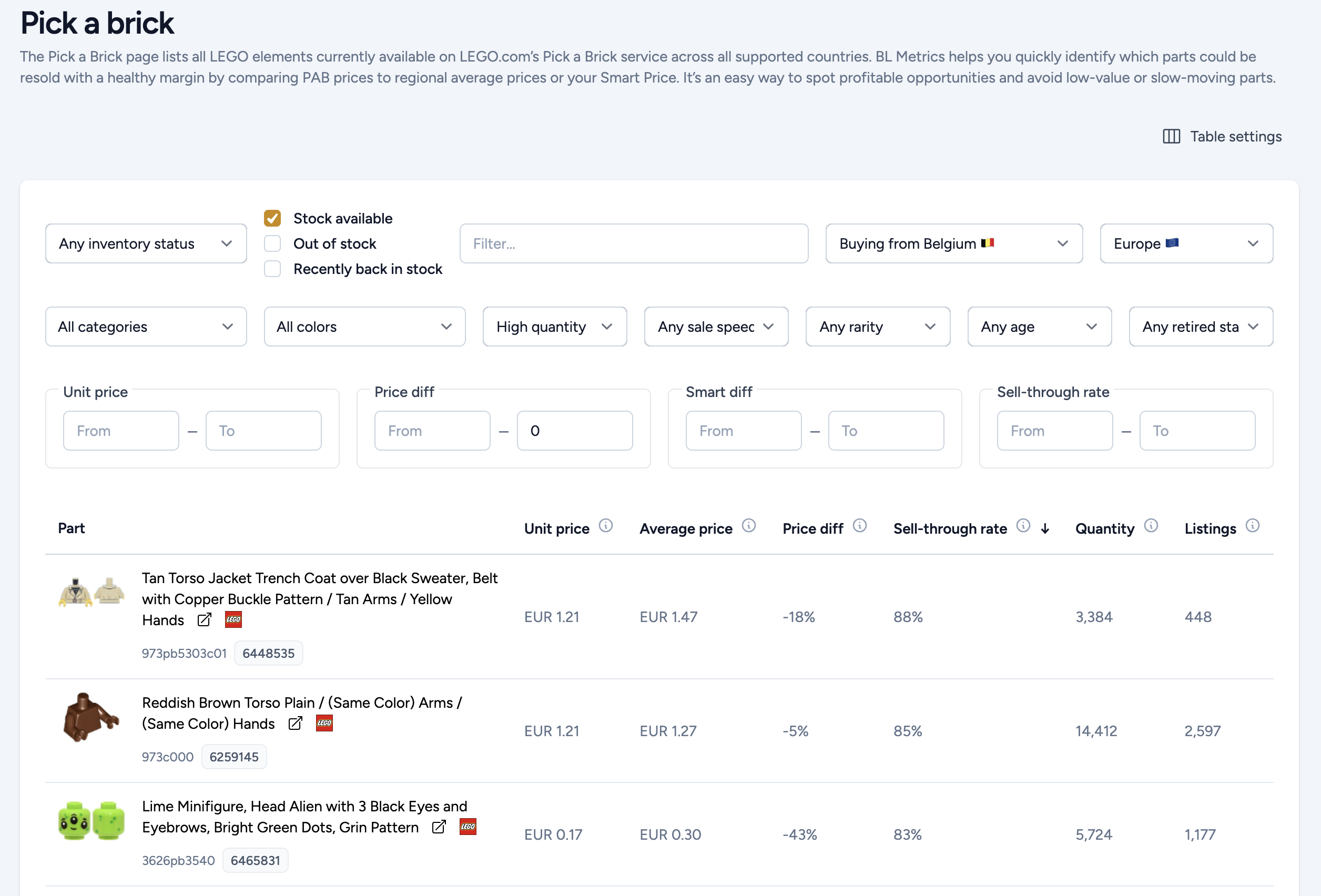
The PAB page on BL Metrics lists every element currently available on Pick a Brick for your region. For each element, you can see:
- LEGO's price for the element
- Bricklink 6-month average price for comparison
- Price difference %: A negative percentage means LEGO is cheaper than the Bricklink average, and you can profit by reselling.
- STR: How fast the part sells on Bricklink.
Sort by price difference or STR to quickly find the best opportunities. You can also filter by whether you already have the item in your inventory, to focus on expanding your catalog.
Back in Stock alerts
PAB availability changes frequently. BL Metrics tracks which items go out of stock and come back, so you can spot restocked elements before others do.
Tips for PAB sourcing
- Sort by price difference and STR: Don't just look for the cheapest parts. The best PAB deals combine a strong price gap and a high Sell-Through Rate, meaning you'll actually move the stock.
- Order in quantity: PAB margins per piece are often slim. Buying larger quantities of a few proven items is more profitable than spreading across dozens of items.
- Time your orders around restocks: Popular elements go out of stock quickly. Use the Back in Stock data to place orders as soon as high-demand items reappear.
4. Buy an Entire Store Inventory
Sometimes the best deal is buying another seller's entire inventory in one go, whether they're retiring from the hobby or liquidating stock. Full store inventories typically sell for around 30% of the 6-month Bricklink average, though this can vary depending on inventory quality and how fast the items sell. This can be a great way to get a large volume of parts at a significant discount, but you need to know what you're buying.
Looking for stores to buy? BrickSellerHub is a free marketplace where sellers list their entire Bricklink stores for sale, a great starting point to find your next acquisition.
Analyze with the BSX Viewer
When a seller offers their inventory for sale, they'll typically provide a BrickStore export file (.bsx). Upload it to the BSX Viewer on BL Metrics to get an instant breakdown:
- Total inventory value using the 6-month Bricklink average
- Per-item analysis with STR, volume, and demand data
- Which items you already carry vs. new additions to your store
This lets you negotiate from a position of knowledge. If the seller wants 30% of Bricklink average, you can see exactly what that means in terms of your expected margins.
Smart Pricing BSX
The Smart Pricing BSX feature goes further by applying your custom pricing formula to every item in the file. This is critical because market averages don't reflect how you price things. If you price conservatively, the average-based valuation overstates your potential revenue. If you price aggressively, it might understate it.
When buying a full store, always ask for a recent BSX export rather than relying on the seller's stated value. Run it through the BSX Viewer to verify.
Tips for buying stores
- Negotiate based on data: Use the BSX Viewer's total valuation as your baseline, not the seller's asking price.
- Check the inventory age: A store with lots of stale inventory (low STR items) is worth less than one with fast-moving stock.
- Factor in overlap: If 80% of their inventory overlaps with yours, you're mostly adding quantity, not variety. That can be good or bad depending on your strategy.
5. Buy Bulk Lots and Sort Them
This is the most hands-on and time-consuming sourcing method, but it can also offer the best margins. Buying unsorted LEGO lots by weight from marketplaces like eBay, Facebook Marketplace, garage sales, or flea markets gives you access to parts at rock-bottom prices.
The tradeoff
Bulk lots are cheap per kilogram, but they require significant labor:
- Washing: Used LEGO often needs cleaning.
- Sorting: Separating parts by type, color, and condition.
- Identifying: Figuring out what each part is (BrickLink's catalog and tools like Brickognize help).
- Listing: Entering each lot into your Bricklink store.
- Quality control: Removing damaged, discolored, or non-LEGO pieces.
Making it work
- Start small: Don't buy 100kg of LEGO before you know if you enjoy the sorting process.
- Specialize: Some sellers focus on specific themes or part types from bulk lots. Sorting only Technic parts or only minifigures can be faster than sorting everything.
- Price by weight wisely: In most markets, a fair price for unsorted used LEGO is around 5-10 EUR/USD per kilogram. Above that, margins get tight.
- Look for treasure: Bulk lots occasionally contain rare minifigures, retired parts, or complete sets. These finds can make or break a lot's profitability.
Building Your Sourcing Strategy
The best Bricklink stores don't rely on a single sourcing method. They combine multiple strategies to maintain a diverse, well-priced inventory:
| Method |
Margin Potential |
Time Investment |
Scalability |
| Set Partouts |
Medium |
Medium |
High |
| Store Arbitrage |
Medium |
Low |
High |
| Pick a Brick |
Medium |
Low |
Medium |
| Full Store Purchase |
Variable |
Medium |
Medium |
| Bulk Lots |
High |
Very High |
Low |
Start with the methods that match your available time and budget. As your store grows, layer in additional sourcing channels. Use BL Metrics to guide your decisions with data rather than guesswork, and you'll build a sourcing pipeline that consistently feeds your store with profitable inventory.
Ready to start? Head to your BL Metrics dashboard and explore the tools mentioned in this guide.